CHARACTERISTICS
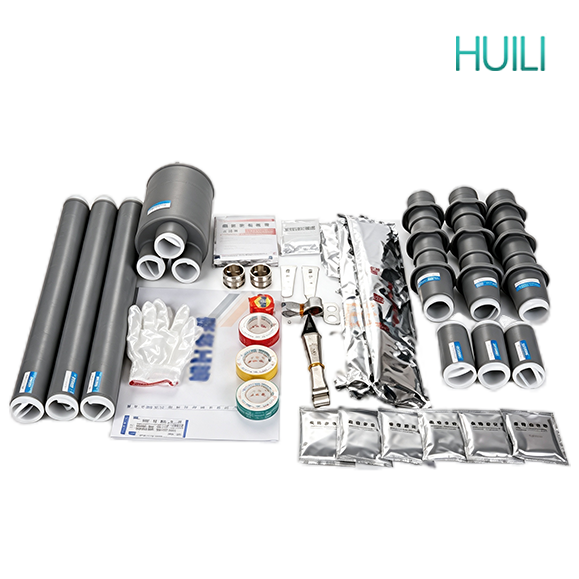
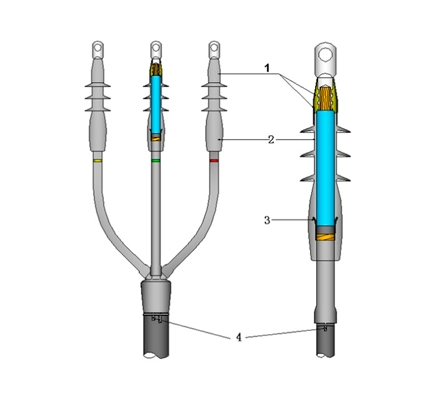
Cold shrink joints use silicone rubber/EPDM high elastomer as the base material, are pre-expanded and formed with built-in support strips, and rely on the elastic memory of the rubber to shrink and wrap the cable. They have six core characteristics: installation and construction, mechanical sealing, electrical insulation, weather resistance and durability, applicable scenarios, and limitations.
I. Installation and Construction Characteristics (Core Advantage)
1. Cold construction without heat source, safe and flameless: No blowtorches or hot air guns are needed; simply remove the internal plastic support strip for automatic shrinkage, completely eliminating the risk of open flame. Suitable for fire-prohibited areas such as oil and gas stations, coal mines, basements, enclosed pipe corridors, and high-altitude areas.
2. Simple operation, minimal human error: Prefabricated integrated structure, no temperature control baking required, no layered heating; easy for beginners to use, significantly reducing common defects in heat shrinking such as bubbles, scorching, and uneven shrinkage, resulting in faster construction.
3. Wide cable size tolerance: The rubber expansion ratio can reach 1.8~2.2 times, with high tolerance for deviations in cable insulation outer diameter. Accessories of the same specification can adapt to various cables with similar cross-sections, reducing the need for stock. 4. Minimal Tools: Only a wire stripping tool is needed; no additional heating equipment is required, offering significant advantages for portable construction at heights and underground.
II. Mechanical and Sealing Characteristics (Long-lasting Waterproofing Core)
1. Constant and Continuous Radial Clamping Force: After retraction, it continuously outputs a uniform radial pressure of 0.3~0.6MPa, elastically deforming in sync with the cable's thermal expansion and contraction, preventing loosening and delamination; even slight bending or displacement of the cable will not cause interface gaps.
2. Seamless Self-adaptive Sealing, Waterproof, Moisture-proof, and Corrosion-resistant: Silicone rubber has strong hydrophobic properties, conforming to the cable's microscopic uneven surface and eliminating interface air gaps; excellent watertight and airtight performance, suitable for direct burial, tunnel flooding, and long-term use in coastal salt spray environments, preventing water ingress and discharge faults.
3. Elastic Buffering, Vibration and Displacement Resistance: The flexible rubber buffer can offset the stress caused by cable thermal expansion and contraction, equipment vibration, and foundation settlement, unlike rigid heat-shrink accessories which may crack or delaminate.
4. Excellent Tear Resistance and Mechanical Toughness: Silicone rubber has high tear resistance, making it resistant to damage from minor impacts on-site. With armoring, it offers even greater resistance to crushing forces.
III. Electrical Insulation and Electric Field Control Characteristics (Key to High-Voltage Reliability)
1. Excellent Dielectric Strength, Creepage Resistance, and Tracking Resistance: Silicone rubber has high insulation resistivity and low dielectric loss, exhibiting strong resistance to tracking. It is less prone to surface flashover in polluted or dusty outdoor environments, making it suitable for 10kV/35kV medium and high voltage cables.
2. Integrated Geometric Stress Cone for Uniformly Distributed Electric Field: Mainstream cold-shrink joints incorporate a pre-fabricated stress cone, smoothly transitioning and shielding the concentrated electric field at the break point. Compared to heat-shrink segmented stress tubes, electric field control is more stable, resulting in extremely low partial discharge during long-term operation and significantly reducing the risk of insulation breakdown.
3. No Interface Air Gap, Suppressing Partial Discharge: Continuous radial pressure compresses the interface, eliminating air gaps and preventing moisture and impurities from forming discharge channels. The failure rate is far lower than that of heat-shrink joints.
IV. Weather-Resistant and Durable Material Characteristics
1. Stable Operation Over a Wide Temperature Range: Applicable temperature range -40℃ to 90℃; does not become brittle at low temperatures or loosen at high temperatures; stable operation in both frigid northern and hot southern environments.
2. Superior Aging Resistance and UV Resistance: Silicone rubber is resistant to UV, ozone, and acid/alkali corrosion; does not powder or crack when laid outdoors; designed service life of 25-30 years, far exceeding the 10-15 year lifespan of heat-shrinkable accessories.
3. Chemical Corrosion Resistance: Resistant to oil, acids, alkalis, and salt spray; highly adaptable to corrosive environments such as chemical plants, coastal areas, and sewage pipe networks.
V. Applicable Scenarios and Characteristics
1. Indoor/Outdoor, Direct Burial, Cable Trench, Tunnel, Cable Tray, Submarine/Underwater, Mine, Chemical Explosion-Proof Areas, High-Altitude Towers;
2. Preferred for projects involving frequent start-stop cycles, large temperature differences, high vibration, dampness, high pollution, and fire-prohibited construction.