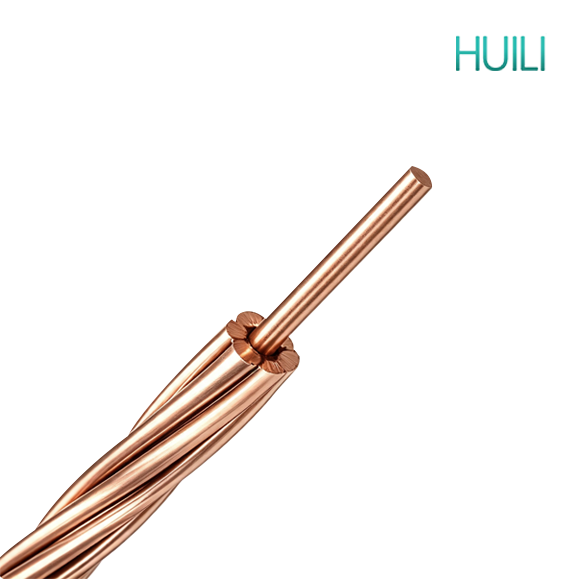
Bare Copper Conductor
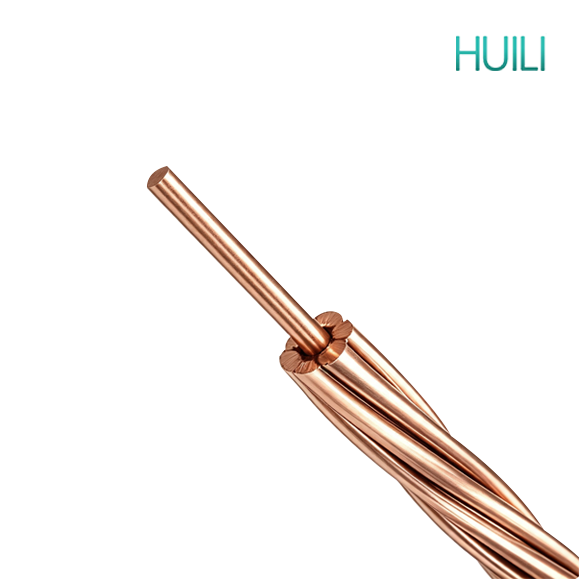
The conductor is concentrically stranded with bare copper wire. Solid or concentric-lay stranded bare copper conductors available in soft, medium-hard, or hard temper.
Home > Products > Bare Conductor
The conductor is concentrically stranded with bare copper wire. Solid or concentric-lay stranded bare copper conductors available in soft, medium-hard, or hard temper.
Bare copper conductor used for overhead electrical distribution lines, grounding electrical substations, electrical test equipment and any other electrical system, suitable for numerous other applications.

The conductor is concentrically stranded with bare copper wire. Solid or concentric-lay stranded bare copper conductors available in soft, medium-hard, or hard temper. Outer layer is right or left hand lay and reversed in successive layers.


Copper boasts excellent electrical conductivity (approx. 100% IACS), far better than aluminum, aluminum alloy, steel-aluminum composite conductors. Same cross-section delivers much larger ampacity and significantly lower power loss.
Non-ferromagnetic copper generates zero hysteresis or eddy current loss under alternating current, ideal for low-loss power transmission and earthing circuits.
Continuous operating temperature up to 90°C; short-time emergency temperature reaches 150°C, outstanding thermal stability against sudden overload.
Stranded design offers great flexibility, easy bending, cutting and terminal crimping; soft copper type is widely used for movable connections.
Copper has higher mechanical strength than AAC, better sag control under tension.
Copper density is much higher than aluminum. Under equal cross-section, bare copper strand weighs far more, which limits its application for long-span overhead power lines.
Hard-drawn copper resists plastic deformation better than soft aluminum, with slow sag growth under long-term tension.
Copper will slowly oxidize and form dark patina in atmospheric environment; patina can slow further internal corrosion but increases contact resistance at clamps and joints.
In coastal salt fog, acid rain and chemical industrial zones, copper suffers accelerated corrosion, resulting in higher resistance and potential breakage risk.
Direct contact between copper and aluminum or galvanized steel creates potential difference, causing severe electrochemical corrosion. Bi-metal transition fittings must be adopted for mixed metal connection.
STANDARD
ASTM B 8
BS 7884
IEC 60228
TB/T 3111
| Size | Nominal Cross Section Area | Approx. Overall Diameter | Approx. Weight | Nominal Breaking Load |
Nominal DC Resistance at 20℃ | |
| AWG | Cmils | mm2 | mm | kg/km | kN | Ω/km |
| 1 | 83690 | 42.4 | 7.35 | 377 | 16.3 | 0.423 |
| 2 | 66360 | 33.6 | 6.54 | 299 | 13.3 | 0.533 |
| 4 | 41740 | 21.2 | 5.19 | 188 | 8.8 | 0.848 |
| 6 | 26240 | 13.3 | 4.12 | 118 | 5.7 | 1.349 |
| 8 | 16510 | 8.4 | 3.26 | 74 | 3.7 | 2.143 |
| 10 | 10380 | 5.3 | 2.59 | 47 | 2.3 | 3.409 |
| 12 | 6530 | 3.3 | 2.05 | 29 | 1.5 | 5.419 |
| 14 | 4110 | 2.1 | 1.63 | 19 | 0.9 | 8.610 |
| 16 | 2580 | 1.3 | 1.29 | 12 | 0.6 | 13.715 |
| 18 | 1620 | 0.8 | 1.02 | 7 | 0.4 | 21.843 |
| Nominal area of cross-section of stranded conductor | Construction (stranding and wire diameter) | Overall diameter of conductor (approx.) | Nominal mass per unit length | Resistance at 20 °C | Minimum breaking load | |
| Nominal | Max. | |||||
| mm² | number/mm | mm | kg/km | Ω/km | Ω/km | N |
| 10 | 7/1.35 | 4.05 | 89.82 | 1.788 | 1.829 | 3752 |
| 14 | 7/1.60 | 4.80 | 126.2 | 1.273 | 1.303 | 5267 |
| 16 | 3/2.65 | 5.70 | 148.3 | 1.082 | 1.106 | 6194 |
| 16 | 7/1.70 | 5.10 | 142.4 | 1.128 | 1.154 | 5946 |
| 25 | 7/2.10 | 6.30 | 217.3 | 0.7391 | 0.7563 | 9073 |
| 32 | 3/3.75 | 8.06 | 296.9 | 0.5405 | 0.5520 | 12400 |
| 32 | 7/2.46 | 7.38 | 298.2 | 0.5386 | 0.5497 | 12442 |
| 35 | 7/2.50 | 7.50 | 308.0 | 0.5215 | 0.5337 | 12860 |
| 50 | 7/3.00 | 9.00 | 443.5 | 0.3622 | 0.3706 | 18520 |
| 50 | 19/1.80 | 9.00 | 435.8 | 0.3727 | 0.3819 | 17700 |
| 70 | 7/3.55 | 10.65 | 621.1 | 0.2586 | 0.2646 | 25930 |
| 70 | 19/2.10 | 10.50 | 593.2 | 0.2738 | 0.2806 | 24090 |
| 95 | 19/2.50 | 12.50 | 840.7 | 0.1932 | 0.1980 | 34140 |
| 100 | 7/4.30 | 12.90 | 911.2 | 0.1763 | 0.1810 | 36540 |
| 120 | 19/2.80 | 14.00 | 1055 | 0.1540 | 0.1578 | 42830 |
| 125 | 19/2.90 | 14.50 | 1131 | 0.1436 | 0.1471 | 45940 |
| 150 | 19/3.20 | 16.00 | 1377 | 0.1180 | 0.1208 | 55940 |
| 150 | 37/2.25 | 15.75 | 1334 | 0.1233 | 0.1264 | 53880 |
| 185 | 19/3.55 | 17.75 | 1695 | 0.09582 | 0.09815 | 68860 |
| 185 | 37/2.50 | 17.50 | 1647 | 0.09981 | 0.1024 | 66490 |
Huili Cable Co., Ltd. (formerly Luohe Huili Cable Co., Ltd. and Luohe Cable Factory) was founded in 1989 and was renamed Huili Cable Co., Ltd. on September 14, 2024. The company's registered capital is RMB 200 million.