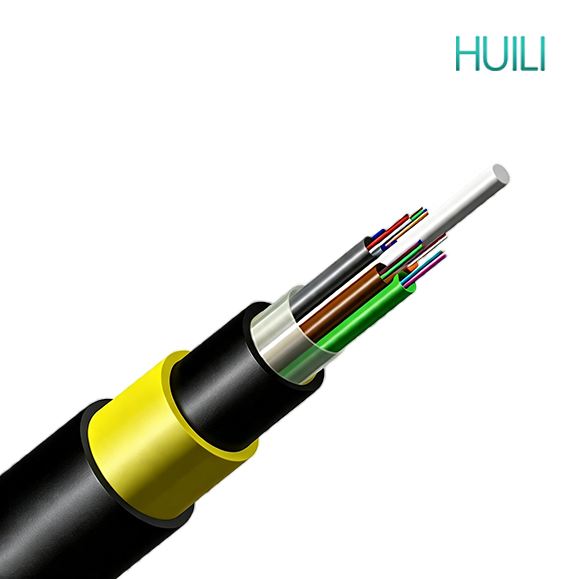
All Dielectric Self Supporting Fibre Cable(ADSS)
ADSS cable's full name is All Dielectric Self Supporting Cable, which is also called non-metallic all-dielectric self-supporting fiber optic cable.
Home > Products > Fiber Optic Cables
ADSS cable's full name is All Dielectric Self Supporting Cable, which is also called non-metallic all-dielectric self-supporting fiber optic cable.
ADSS is widely used in power communication systems for its advantages of large fiber core number, lightweight, no metal (all-medium), and can be set up with power lines and towers, generally without power outage construction.
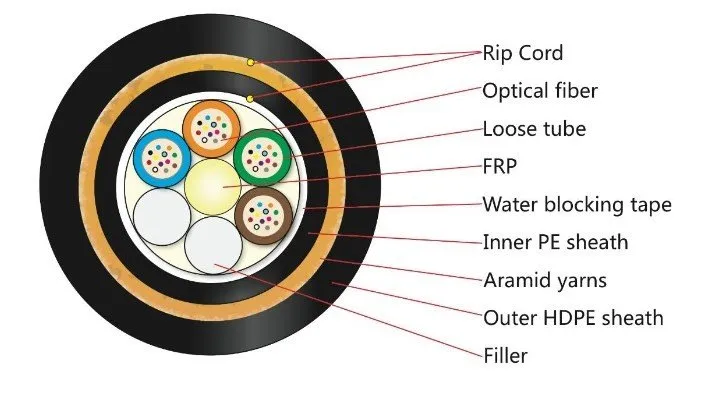
I. Structural Characteristics (Two Mainstream Structures)
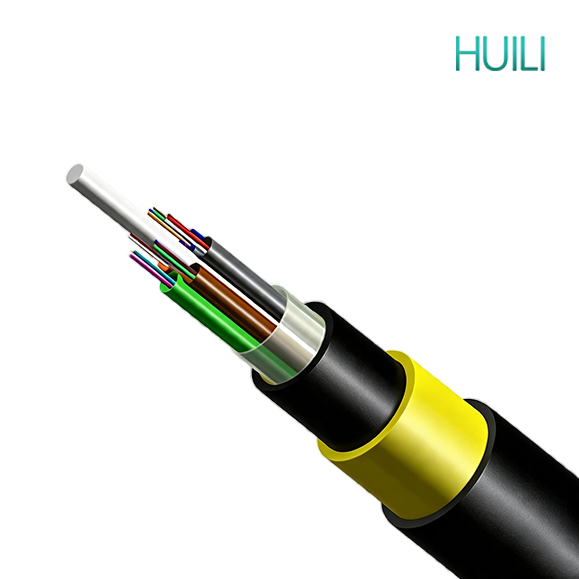
Layer-Stranded ADSS (Mainstream for High Core Count)
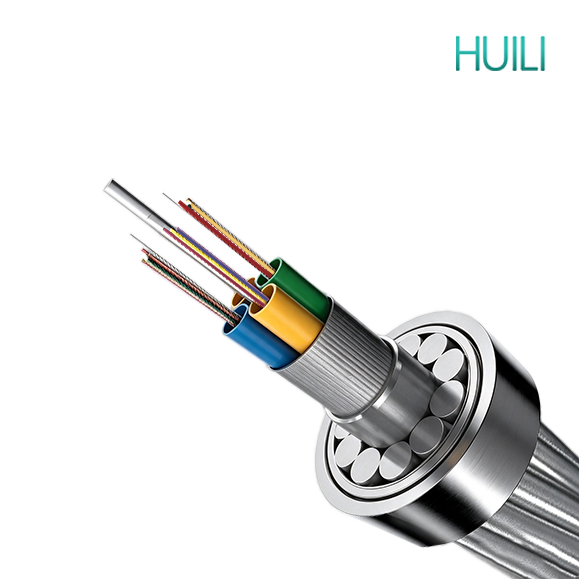
1. Optical Fiber: 250μm colored optical fiber placed in a PBT high-modulus loose tube, filled with waterproof grease;
2. Central Reinforcing Core: FRP non-metallic glass fiber rod, no metal;
3. Cable Core: Loose tube + filler rope stranded around FRP, gaps filled with water-blocking grease;
4. Inner Sheath: PE polyethylene isolation layer;
5. Tensile Reinforcing Layer: Bidirectional stranded aramid yarn (Kevlar), providing full self-supporting tensile strength;
6. Outer Sheath: Ordinary PE sheath / AT tracking resistant sheath (high voltage dedicated).
Center-Tube ADSS (Small Core Count, Lightweight)
The optical fiber loose tube is placed in the very center of the optical cable, the outer layer directly wraps around aramid yarn + sheath, without an FRP central rod.
II. Core Electrical Insulation Characteristics (Maximum Advantage of All-Dielectric Structure)
1. Zero Metal Components: No steel wires, aluminum tubes, metal reinforcing cores, or metal shielding layers; all components are insulating polymer media.
2. Complete Electromagnetic Interference Resistance: No induced currents, eddy currents, or signal interference near high-voltage transmission lines, ensuring stable communication.
3. Excellent Lightning Protection: Does not attract lightning or conduct lightning-induced voltage, suitable for mountainous areas prone to lightning strikes.
4. No Electrochemical Corrosion: No metal electrochemical corrosion; longer lifespan in humid and coastal environments.
III. Mechanical Characteristics (Self-Supporting Core)
1. Self-Supporting Tensile Structure: Relies on aramid yarn to bear the entire overhead load, eliminating the need for additional steel strand suspension wires; directly hangs the tower.
2. Large Span Capacity: Standard span 50–800m; special large-span models can exceed 1000m, suitable for crossing rivers and valleys.
3. Lightweight and Low Load: Small cable diameter and low unit weight significantly reduce tower load. Pole wind load and icing load, reducing pole and tower modification costs;
IV. Waterproofing, Moisture-proofing, and Environmental Weather Resistance
1. Full-section Water Blocking: Loose tube filling grease + cable core water-blocking grease + double-layer sealing sheath, providing longitudinal and transverse waterproofing, preventing water seepage in underground water accumulation and high-humidity mountainous areas;
2. Wide Temperature Range Applicability: Operating temperature range is generally -40℃~+70℃, with minimal fiber attenuation fluctuations during high and low temperature cycles;
3. Weather Resistance and Aging Resistance: Black PE/AT sheath with added UV-resistant additives, preventing cracking and powdering under long-term outdoor exposure;
V. Optical Transmission Characteristics
1. Uses standard single-mode/multimode optical fiber, low attenuation, high bandwidth, meeting the needs of power dispatching, protection channels, 5G backhaul, and broadband private networks;
2. Loose tube structure provides ample fiber length, ensuring the fiber is not stressed when the cable is stretched or bent, resulting in stable attenuation;
ISO 9001
ISO 14001
IEC60793-1
IEC60793-2
ITU-T G.650
ITU-T G.652
IEC60794-3-10
IEC60794-3-20
| Fiber count |
Structure | Fibers per tube |
Loose tube diameter (mm) |
CSM diameter /pad diameter (mm) |
Nominal Thickness of outer jacket (mm) |
Cable diameter /Height (mm) |
Cable weight (kg/km) |
Tensile resistance Long/short term N |
Crush resistance Long/short term N/100m |
| 4 | 1+6 | 4 | 2.0±0.1 | 2.0/2.0 | 1.75 | 9.5±0.3 | 65 | 1500/4000 | 300/1000 |
| 6 | 1+6 | 6 | 2.0±0.1 | 2.0/2.0 | 1.9 | 9.8±0.3 | 70 | 1500/4000 | 300/1000 |
| 8 | 1+6 | 8 | 2.0±0.1 | 2.0/2.0 | 1.9 | 9.8±0.3 | 70 | 1500/4000 | 300/1000 |
| 12 | 1+6 | 6 | 2.0±0.1 | 2.0/2.0 | 1.9 | 9.8±0.3 | 70 | 1500/4000 | 300/1000 |
| 24 | 1+6 | 6 | 2.0±0.1 | 2.0/2.0 | 1.9 | 9.8±0.3 | 70 | 1500/4000 | 300/1000 |
| 36 | 1+6 | 12 | 2.1±0.1 | 2.2/2.2 | 1.9 | 10.2±0.3 | 82 | 1500/4000 | 300/1000 |
| 48 | 1+6 | 12 | 2.1±0.1 | 2.2/2.2 | 1.9 | 10.2±0.3 | 82 | 1500/4000 | 300/1000 |
| 60 | 1+6 | 12 | 2.1±0.1 | 2.2/2.2 | 1.9 | 10.2±0.3 | 85 | 1500/4000 | 300/1000 |
| 72 | 1+6 | 12 | 2.1±0.1 | 2.2/2.2 | 1.9 | 10.2±0.3 | 88 | 1500/4000 | 300/1000 |
| 96 | 1+8 | 12 | 2.1±0.1 | 2.2/3.6 | 2 | 12.0±0.3 | 110 | 1500/4000 | 300/1000 |
| 144 | 1+12 | 12 | 2.1±0.1 | 2.4/6.3 | 2 | 14.5±0.3 | 155 | 1500/4000 | 300/1000 |
| 216 | 1+6+12 | 12 | 2.1±0.1 | 2.2/2.2 | 2.05 | 14.7±0.3 | 165 | 1500/4000 | 300/1000 |
| 288 | 1+9+15 | 12 | 2.1±0.1 | 2.2/4.0 | 2.05 | 16.5±0.3 | 220 | 1500/4000 | 300/1000 |
| Characteristics | Specified Values | Units | ||
| Optical Characteristics | ||||
| Mode field diameter | at 1310nm | 9.2±0.5 | µm | |
| at 1550nm | 10.3 ±0.7 | mm | ||
| Attenuation coefficient | at 1310nm | ≤0.32 | dB/km | |
| at 1550nm | ≤0.22 | dB/km | ||
| Attenuation non-uniformity | ≤0.05 | dB | ||
| Zero dispersion wavelength ( λ0) | 1300 ~1324 | nm | ||
| Max zero dispersion slope (S0max) | ≤0.092 | ps/(nm2·km) | ||
| Polarization mode dispersion coefficient(PMDQ) | ≤0.2 | |||
| Cut-off wavelength (λcc) | ≤1260 | nm | ||
| Dispersion coefficient | 1288~1339nm | ≤3.5 | ps/(nm·km) | |
| 1550nm | ≤18 | ps/(nm·km) | ||
| Geometric characteristic | ||||
| Cladding diameter | 125.0±1.0 | µm | ||
| Cladding non-circularity | ≤1.0 | % | ||
| Coating diameter | 245.0±10.0 | µm | ||
| Coating-cladding concentricity error | ≤12.0 | µm | ||
| Coating non-circularity | ≤6.0 | % | ||
| Core-cladding concentricity error | ≤0.8 | µm | ||
| Mechanical characteristic | ||||
| Curling | ≥4 | m | ||
| Proof stress | ≥0.69 | GPa | ||
| Coating strip force | Average value | 1.0-5.0 | N | |
| Peak value | 1.3-8.9 | N | ||
| Macro bending loss | Ф60mm, 100 circles, at 1550nm | ≤0.05 | dB | |
| Ф32mm, 1 circles, at 1550nm | ≤0.05 | dB | ||
Huili Cable Co., Ltd. (formerly Luohe Huili Cable Co., Ltd. and Luohe Cable Factory) was founded in 1989 and was renamed Huili Cable Co., Ltd. on September 14, 2024. The company's registered capital is RMB 200 million.